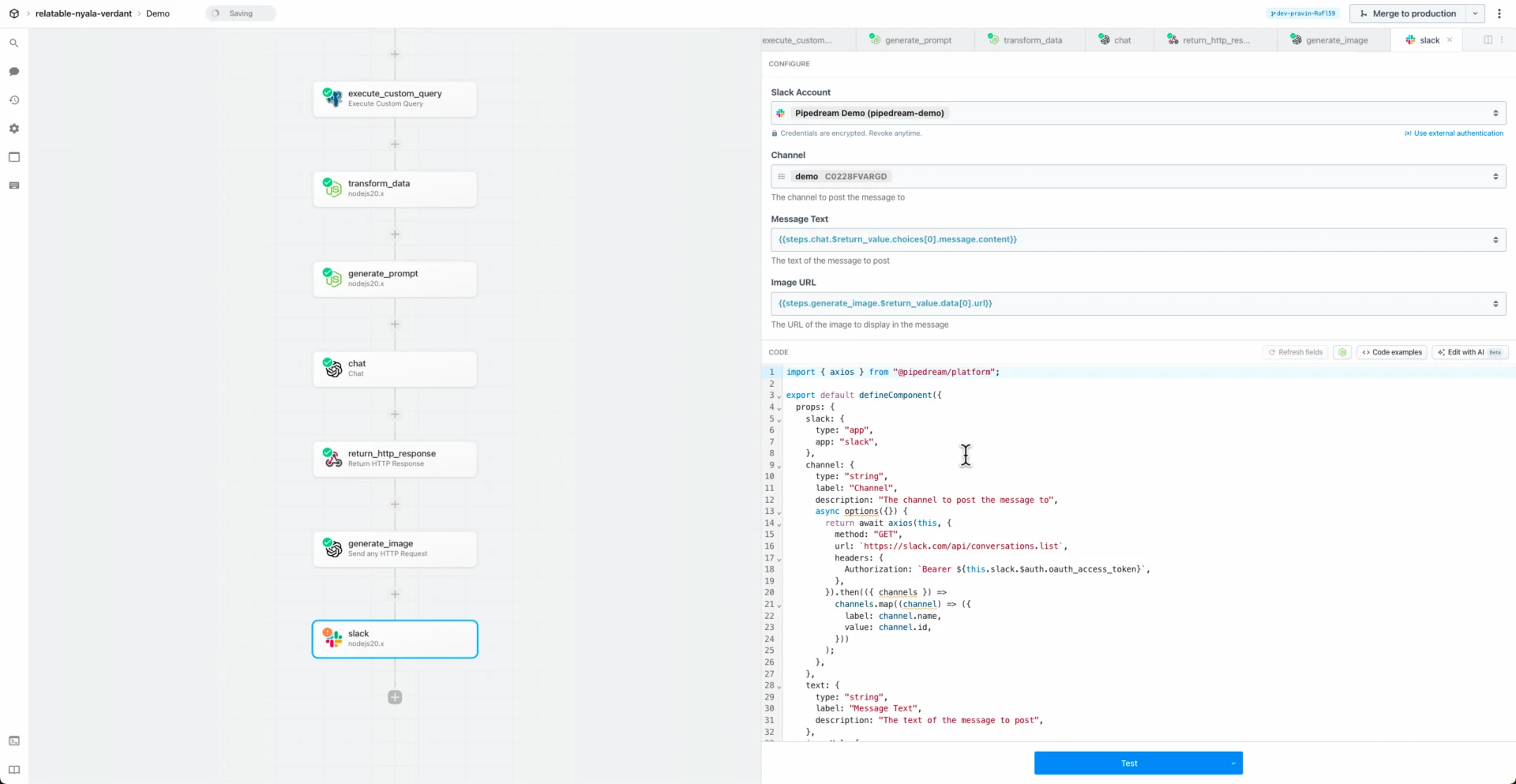
import app from "../../stripe.app.mjs";

export default {
  key: "stripe-create-product",
  name: "Create Product",
  description: "Creates a new product object in Stripe. [See the documentation](https://stripe.com/docs/api/products/create).",
  version: "0.0.5",
  annotations: {
    destructiveHint: false,
    openWorldHint: true,
    readOnlyHint: false,
  },
  type: "action",
  props: {
    app,
    name: {
      description: "The product's name, meant to be displayable to the customer.",
      optional: false,
      propDefinition: [
        app,
        "name",
      ],
    },
    active: {
      description: "Whether the product is currently available for purchase. Defaults to true.",
      propDefinition: [
        app,
        "active",
      ],
    },
    unitLabel: {
      type: "string",
      label: "Unit Label",
      description: "A label that represents units of this product. When set, this will be included in customers receipts, invoices, Checkout, and the customer portal.",
      optional: true,
    },
    country: {
      propDefinition: [
        app,
        "country",
      ],
    },
    defaultPriceDataUnitAmount: {
      label: "Default Price Data - Unit Amount",
      description: "A positive integer in cents (or `0` for a free price) representing how much to charge. One of **Unit Amount** or **Unit Amount Decimal** is required.",
      propDefinition: [
        app,
        "unitAmount",
      ],
    },
    defaultPriceDataUnitAmountDecimal: {
      label: "Default Price Data - Unit Amount Decimal",
      propDefinition: [
        app,
        "unitAmountDecimal",
      ],
    },
    defaultPriceDataCurrency: {
      label: "Default Price Data - Currency",
      propDefinition: [
        app,
        "currency",
        ({ country }) => ({
          country,
        }),
      ],
    },
    defaultPriceDataRecurringInterval: {
      label: "Default Price Data - Recurring - Interval",
      optional: true,
      propDefinition: [
        app,
        "recurringInterval",
      ],
    },
  },
  methods: {
    createProduct(args = {}) {
      return this.app.sdk().products.create(args);
    },
  },
  async run({ $ }) {
    const {
      createProduct,
      name,
      defaultPriceDataUnitAmount,
      defaultPriceDataUnitAmountDecimal,
      active,
      unitLabel,
      defaultPriceDataCurrency,
      defaultPriceDataRecurringInterval,
    } = this;

    const response = await createProduct({
      name,
      active,
      unit_label: unitLabel,
      ...(
        defaultPriceDataCurrency
        || defaultPriceDataUnitAmount
        || defaultPriceDataUnitAmountDecimal
        || defaultPriceDataRecurringInterval
          ? {
            default_price_data: {
              currency: defaultPriceDataCurrency,
              recurring: {
                interval: defaultPriceDataRecurringInterval,
              },
              unit_amount: defaultPriceDataUnitAmount,
              unit_amount_decimal: defaultPriceDataUnitAmountDecimal,
            },
          }
          : {}
      ),
    });

    $.export("$summary", `Successfully created a new product with ID \`${response.id}\`.`);

    return response;
  },
};


















 Chase Roberts@chsrbrts@benedictevans If you haven’t used @pipedream yet, then you haven’t lived.
 ✨Ellie Day✨@heyelliedayEvaluation update: @pipedream has quite literally been a dream to work with! I’m excited to leverage this tool for all the various workflows I need to write. I’m currently at 11k invocations a day from the initial workflows I’ve written in the past couple weeks.
 Michael Braedley@MBraedleyUpdate: I got it working properly, and it's working so well that I'm dropping IFTTT. @pipedream can do everything that IFTTT basic can, and most (if not all things) IFTTT pro can for free or at a reasonable price if you need it. I am recommending it for basically any power user.
 Thomas Cutting@mrthomascuttingWant quick+dirty integrations for a serverless workflow - @pipedream is my new go-to 😃
 Matthew Roberts@mattdotrobertsday 013 - finally hit node js. This is the secret sauce of taking #nocode projects that one step further. Pumped about getting deeper into @pipedream now
 Kenneth Auchenberg 💭@auchenbergYahoo Pipes is back! Kinda 😍 @pipedream
 Raymond Camden 🥑@raymondcamdenAwesome video by the @pipedream folks showing real time twitter sentiment analysis integrated with Google Sheets. This is where Pipedream *really* shines, connecting systems together in easy workflows.
 Nacho Caballero@nachocaballeroI couldn't recommend @pipedream more. It's an amazing service to integrate different APIs. Much more powerful than Zapier and more user-friendly than AWS Lambda. I'm very proud to wear this t-shirt #NoCode
 Jason Snow@jyksnwDeveloped a working prototype environmental sensor IoT solution with @particle Photon, @pipedream, and @MongoDB with full graphing and alerting in less than a day! All amazing technology, will def. be exploring these more.
 Steven Terrana@steven_terrana@burgwyn you've inspired me to finally set up my own blog. I'll make sure my first blog post explains the tech behind the setup. think @obsdmd + @GatsbyJS + @pipedream.
 🚄 James Augeri, PhD@DotDotJamesWant to low-code your back end, need more horsepower than @Bubble / @KnackHQ, or just miss Yahoo! Pipes? Check out @PipeDream
 Sébastien Chopin@AtinuxGitHub issues should be like @linear_app for maintainers. Looking forward more integrations with GH actions or tools like @pipedream 👀
 Raul@raul_predescuIf you're a dev and not using @pipedream, you're missing out. Been using it for months, daily. FREE for devs. Plenty of integrations and good limits. Absolutely love it.
 Bruno Skvorc@bitfallsSo @pipedream is pretty amazing. In 3 minutes I just made a flow which adds @rickastley's Never Gonna Give You Up to my @spotify playlist whenever a new pull request arrives in an old repo of mine.
 Zach Lanich@ZachLanichUm, wow 🤯 @pipedream
 Steven Bell@bellontechI just used @pipedream to build a Shopify App. Wow, they make small backed tasks easy.
 Jay Hack 🎩🇺🇸@_jayhack_Very impressed with this bad boi - it reminds me of a @PalantirTech internal tool, but geared towards integrations instead of data analysis and far more customizable. Great expectations here 🚀🤩
 Tree Sturgeon 🔥🚴♂️🌳@philsturgeonFor context this is day 2 of a really challenging and stupid migration from Notion to @airtable with disparate/missing data. It's going better than expected and thanks to @pipedream I don't have to bother the iOS dev to add W3W.